

Behaviour change interventions are deliberate actions, programmes or policies designed to influence the decisions and habits of individuals or groups. They can range from public health campaigns and workplace initiatives to digital apps and changes in law or policy. At their core, interventions aim to close the gap between what people intend to do and what they actually do. However, well-meaning initiatives do not always lead to meaningful change. Designing interventions that are evidence-based, drawing on behavioural science theory, empirical research and real-world evaluation, increases the likelihood that they will be effective.
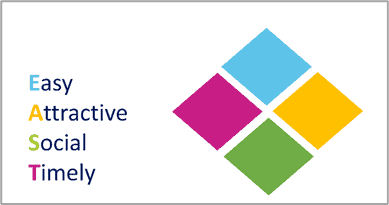
The process of designing interventions might seem complicated, but there are some simple frameworks we can use to help us. The EAST framework (Behavioural Insights Team, 2024) provides a guide to simplifying behaviour change. In this framework, behaviour change interventions should aim to be Easy, Attractive, Social and Timely.
Easy
As humans, we like to take the path of least resistance; we can play on this concept with our interventions. There are several approaches we can use to make desirable behaviours easier for people to carry out. Firstly, we could consider using default options such as opt out systems. For example, in hospitals in London, an opt out system was introduced for blood testing in emergency departments so that blood being tested automatically tested for HIV, hepatitis B and hepatitis C (NHS England 2022).
If it is not possible or practicable to use default options, an alternative approach may be to reduce friction to the desirable behaviour. For example, Vandenbroele et al. (2021) found that placing meat substitutes next to meat products, rather than in a separate vegetarian section, increased sales of meat substitutes by 171% in a Belgian supermarket. This can also work in the opposite way; we can make an undesirable behaviour more difficult by increasing friction. A good example of this is the smoking ban in England in 2007, which made it illegal to smoke in public places and workplaces so that people have to go outside to smoke. Since the ban came into place in 2007, smoking rates have dropped from 21% to 13% (Fingertips, 2025).
Another approach to make a desirable behaviour easier is to simplify communication to make our interventions easy. Make sure any wording you use is clear and easy to understand, making any key messages stand out as much as possible. For example, Fishbane, Ouss and Shah (2020) found that redesigning court summons forms in New York City reduced the number of people who failed to appear in court by 13%. The new form made the most relevant information (e.g., the court date, location and the consequences of not showing up) clearer, preventing around 17,000 arrest warrants per year.
Attractive
Interventions are more effective when they are something that feels novel and something that we enjoy. A few things to consider when trying to make your intervention more attractive are:
- Attracting attention with bright colours, personalisation and by highlighting appealing aspects of your intervention;
- Provide incentives to encourage behaviour (e.g., financial rewards, stickers, badges, awards, etc.);
- Use gamification to make our intervention more attractive.

Social
Social norms guide behaviour through societal values and expectations, with two key types:
- Descriptive norms, which show what most people do;
- Injunctive norms, which indicate what is approved or disapproved.
We can draw on this idea with our interventions by highlighting when the desirable behaviour is what most people are doing, or when it is something that is socially approved of. We can also highlight when an undesirable behaviour is not socially acceptable.
As we as humans are likely to absorb the behaviour of others around us, we should consider opportunities to spread a behaviour through social networks (e.g., families, social groups, communities).
Timely
Timing is important in behaviour change. When designing an intervention, we should consider how daily and weekly patterns could be targeted as well as thinking about life events or transitions. Clear plans with start and end dates can also support behaviour change.
Timing can be particularly powerful when linked to the “fresh start effect”, these are moments such as New Year, birthdays, the start of a new week or moving to a new home, momentous occasions or life milestones when people are feel primed to make a change. Interventions introduced at these transition points can feel more motivating because they symbolise a ‘clean slate’. Similarly, prompting people to form specific plans (e.g., “If it is Monday at 7am, I will go for a run”) can increase follow-through by turning vague intentions into commitments. Designing interventions around moments of change, disruption or routine formation can therefore significantly strengthen their impact.
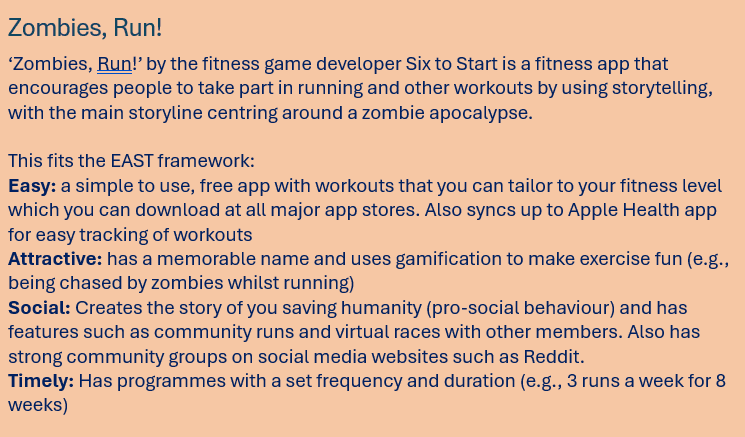
A real world example of how EAST can be applied.
Ultimately, effective behaviour change does not always require large-scale campaigns or heavy regulation. Often, small and well-designed adjustments to the environment such as making making behaviours Easy, Attractive, Social and Timely, can produce measurable shifts. The EAST framework offers a practical starting point, but its success depends on careful diagnosis, ethical implementation and ongoing evaluation. Thoughtful design, rather than sheer persuasion, is often the key to lasting change.
If you or your organisation would like some support in designing effective interventions please get in touch to see how we can help.